Saturday, March 30, 2013

Turn off The Lights

Neil deGrasses Tyson, astrophysicist at the Hayden Planetarium in New York City, eloquently summarizes one of the humanistic values of the night sky: “You could live your life at home never looking up…. [But] I … submit to you that you’ll be missing a point of view,…a cosmic perspective, because …you’ll start thinking of your own environment as all there is. And if that’s how you think about where you are, then it rises to an artificial level of importance to you, whereas, when you look at the night sky and you realize how small we are within the cosmos, it’s kind of a resetting of your ego. To deny yourself of that state of mind, either willingly or unwittingly, in my judgment, is to not live to the full extent of what it is to be human” (qtd. in City Dark). This quoted passage is definitely my favorite out of all the choices, simply because it’s self-explanatory. To expound on it even more, Neil is explaining how an individual can live their life without noticing or gazing up at the night sky and become blinded to all the universe has to offer. Staring gazing is more spiritual than it is practical. To not have that kind of experience, you are missing out on the aesthetic beauty of the sky. When you look up at the sky, you realize how small you are compared to the universe. It is like we were born into this big mystery that you can never figure out how, but only God knows, because He is the creator of this marvelous world.
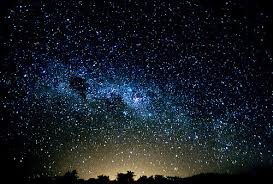
Gods wonderful creation.

According to director Ian Cheney, “There is controversy over whether more light leads to less crime, but there is agreement that light seems to make people feel safer, almost like it’s built into our genes to move closer to the campfire or to the brightest city” (City Dark).  Ian Cheney statement is simply explaining how we as humans feel safer when surrounded by light because we are afraid of the things we cannot see. The dark puts us out of our comfort zone. Our world would be a complete mess, specifically dealing with crime, if we had no electric lights shining throughout the night, other than the stars that shine above. I’m pretty sure that many people would be able to relate to Cheney's statement. A prime example was shown in the film when Ian parents installed a bright light on top of their barn due to someone breaking into it. This is why some people that fear crime and are afraid of the darkness at night, install motions detectors around their houses to detect an individual’s motion. Many people rely on this system because it’s a great way to alert the home owner for criminals, it’s kind of like a security system.
How light bleeds into space.
 Unfortunately, all of the lights that are set up for use, doesn’t all shine on the ground, but rather bleeds off into space causing it harder to view the night sky. To prevent losing the night sky completely, I think we should only put light where we need it the most, not in areas that doesn’t find it useful.  

Tuesday, March 26, 2013

Our Vanishing Night Sky

Ian Cheney, the filmmaker of The City Dark, explains how after he moved from the rural area of New England to New York City, he felt like he “was at the center of the world” but that he had “left something important behind, something [he] couldn’t name.” He also wonders, “What do we lose when we lose the night?” (City Dark).  Ian is saying, if we don’t try to help preserve the night sky, we will lose our clear view of the wonders it holds. Everyone who is in fear of losing the night sky can see how it is important to make wise choices about outdoor lighting, and that together we can work to restore the night sky to its former glory.

Chad Moore, of the National Parks Service, reminds us, “When we add light to the environment, that has the potential to disrupt habitat, just like running a bulldozer over the landscape can. Darkness is a necessary habitat for nocturnal animals, so what’s the habitat for people?” (qtd. In City Dark). Chad is simply explaining that life on Earth has existed with a regular and dependable day and night schedule to the illumination levels in the environment. This regularity has become ingrained into the DNA of species up and down the evolutionary tree. It regularizes basic and fundamental biological activities across species from plants and to even us, humans. It is the height of apathetic ignorance and insanity that we expect other living organisms on this planet to just "adapt" to newly created lighting schedules of our convenience. The effects of light pollution on plants and animals in the environment are numerous, and are becoming more known. By watching the film, it simply reminds us as humans, how big of an impact light pollution has on the birds and newly born turtles. Birds use the bright stars in the sky to determine the route for the next day, and when the city lights interfere with their view, birds can become confused and disoriented. Unfortunately, light pollution also causes some birds to give in to deadly collisions with buildings and other objects in the sky that may be difficult to see when "blinded by the light".  Similarly, light pollution is at the heart of the decline of sea turtles. It impacts their nesting habits and the ability of young hatchlings to survive, as seen in the film. I recently became educated on how it has been said that by working graveyard shifts under fluorescent lights, disturbing the daily rhythmic flow, increases the risk of developing cancer. So these are prime examples why we need to protect the night sky from having a negative impact on the animals and even ourselves.


We rarely stop to think that the night is necessary and good for life. Therefore, we do not realize that protecting the night sky is a valuable step to conserving bio-diversity. Most people think that as we sleep at night, the rest of the species do the same, it is of no concern if we send out a light into the night time environment. However, our action of light pollution alters and interferes with nocturnal species that begin their daily activities at sundown and can also interfere with ours.

Tuesday, March 12, 2013

Gazing up at The Night Sky

I got my first really great view of the night sky during a late beautiful clear summer night when I was about twelve years old. Getting ready to go back inside the house from playing outside with the neighborhood kids, I started to notice the stars in the sky. Curiosity and awe lead the way and I stopped where I was to study the night sky.


I had looked at the stars before, but this night was different. The stars were brilliant. I had never realized that there were so many stars in the night sky before. I had never seen so many stars shining through. It had just happened to be a perfect night for star gazing. I was far from the glare of the lights of town and it was also a moonless night. It was nearly pitch black and the trees were silhouetted against the night sky. To have this incredible view of the stars with my very own eyes was amazing.

I have star gazed numerous times since that night, and it has never been as magnificent as it was on that night. Seeing the night sky that night was like a dream. I got a great view of what our atmosphere does so well at hiding from us, and I was now aware of so much more. But I also believe that my star gazing has not ever been as good as it was on that night because the conditions have never been as good as they were with all the pollution in the Baytown area.

I think every person should have the opportunity to have such a great look at the universe at least once during their lifetime. Pictures and words do a great job of describing the beautiful universe, but seeing it and experiencing it in real life is a whole lot better.
 
I’m pretty sure that the night sky was much more fabulous back in the day due to less polluted air. As I did research on how light pollution affects the night sky, it has been proven that both individuals and major business are the actual cause of light pollution.  Now-a-days it is very difficult to spot a star shining in the night sky. Often times I look up at the sky and wonder where all the stars have gone, and be reminded that the sky is full of unnatural lighting that humankind has surrounded itself with. This global issue known as light pollution is the result of misguided and wasteful lighting practices. It also represents a major threat to astronomer’s ability to see any of our current visible skylines. Light pollution is known by their adverse effects on the health of animals, plants, humans and the environment. But it is very important to protect the night sky to prevent this from happening.

The night sky is designed to be used. In earlier years, individuals often used the night sky for navigation and to keep track of time. However, in today’s age and time we no longer do so. We rely on technology and navigation systems in our cars and on our phones to help us with directions, not so much on the stars in the sky.  

Monday, March 4, 2013

DEATH !


“Windowgrave” Vs. “Reading the Obituary Page”


Death is the total and permanent cessation of all the vital functions of a living organism; the end of an individual or animals life.  The two poems I have chosen are very unique in how they approach death.  The poem “Windowgrave” by Eamon Grennan address death as either going to heaven or hell, whereas the poem “Reading the Obituary Page” by Linda Pastan address death as a continuous life cycle.

After reading “Windowgrave”, I came to the conclusion that poet is describing death from an insect point of view but is really referring the message towards humans. The poet describes how “The dead bee lies on the window ledge, a relic” meaning a surviving memorial of something past (Grennan 1).  That line makes me think of how people attend a funeral and how they remember that individual’s life when they once were alive. Then the poem defines how an individual is put away in their caskets and buried by saying the “dust gathering on every follicle/ and on the geodesic dome of the head—all tucked in/ and tucked away, so neat is death (3-5). I like how the poet also describes how the insects are “lying on their sides as if /asleep” whereas human lay on their backs (6-7). The approach of the message is further expressed as he continue to demonstrate how they are taking “just a quick nap and they’ll be up and off/ about their business” (7-8). This demonstrates us as people that when we die it is just a short nap and we will be resurrected into new life. The fact that the poet described how “the air [is] crowded and loud with leftover angels”, expresses how they are happy and rejoicing that their souls are rising up into to God’s kingdom.  The impression the poet gives about the spider makes me think that the spider is someone who doesn’t believe in God simply because he explains that it has “fallen/ from grace but walking on air, vigilant in ways/ that harden the heart” (11-13).  Hardness of the heart describes a negative condition in which the person rejects the gracious offer of God to be a part of his or her life; which ultimately leads them to hell.

Dissimilar to “Windowgrave”, Linda Pastan’s poem “Reading the Obituary Page” approaches death differently in a way that she focuses more on the cycle of death. The poem begins describing the clothes of young boys and girls, “In starched dresses/ with ribbons/ in miniature jackets/ and tiny ties”, something that they would wear in a casket (Pastan 1-4). But, the boys and girls are all dressed up because they are at a birthday party and at the party they play a game of musical chairs. The narrator illustrates how “[they] would circle/ the chairs/ at birthday parties and/ when the music/ stopped, lunged/ to be seated” (6-10). The narrator reveals to the readers that during the cycle of death there is always going to be one individual that loses a chair, meaning loses his or her life. I love how the poet phrased the last line in the poem when she says, “One/ by one we were welcomed/ to hard ground/ and empty air (10-13). As the game of musical chairs continues, there will always be one person that will no longer have a chair in life, but a place in the ground.

However, both poems were amazingly interesting in the way it described death. Even though “Windowgrave” was more about dying and going to heaven or hell and “Reading the Obituary Page” focused more on the cycle of death they both explained death in a very unique way.