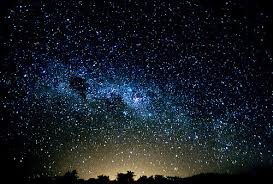
Neil deGrasses Tyson, astrophysicist at the Hayden Planetarium in New York City, eloquently summarizes one of the humanistic values of the night sky: “You could live your life at home never looking up…. [But] I … submit to you that you’ll be missing a point of view,…a cosmic perspective, because …you’ll start thinking of your own environment as all there is. And if that’s how you think about where you are, then it rises to an artificial level of importance to you, whereas, when you look at the night sky and you realize how small we are within the cosmos, it’s kind of a resetting of your ego. To deny yourself of that state of mind, either willingly or unwittingly, in my judgment, is to not live to the full extent of what it is to be human” (qtd. in City Dark). This quoted passage is definitely my favorite out of all the choices, simply because it’s self-explanatory. To expound on it even more, Neil is explaining how an individual can live their life without noticing or gazing up at the night sky and become blinded to all the universe has to offer. Staring gazing is more spiritual than it is practical. To not have that kind of experience, you are missing out on the aesthetic beauty of the sky. When you look up at the sky, you realize how small you are compared to the universe. It is like we were born into this big mystery that you can never figure out how, but only God knows, because He is the creator of this marvelous world.
According to director Ian Cheney, “There is controversy over whether more light leads to less crime, but there is agreement that light seems to make people feel safer, almost like it’s built into our genes to move closer to the campfire or to the brightest city” (City Dark). Ian Cheney statement is simply explaining how we as humans feel safer when surrounded by light because we are afraid of the things we cannot see. The dark puts us out of our comfort zone. Our world would be a complete mess, specifically dealing with crime, if we had no electric lights shining throughout the night, other than the stars that shine above. I’m pretty sure that many people would be able to relate to Cheney's statement. A prime example was shown in the film when Ian parents installed a bright light on top of their barn due to someone breaking into it. This is why some people that fear crime and are afraid of the darkness at night, install motions detectors around their houses to detect an individual’s motion. Many people rely on this system because it’s a great way to alert the home owner for criminals, it’s kind of like a security system.
Gods wonderful creation.
According to director Ian Cheney, “There is controversy over whether more light leads to less crime, but there is agreement that light seems to make people feel safer, almost like it’s built into our genes to move closer to the campfire or to the brightest city” (City Dark). Ian Cheney statement is simply explaining how we as humans feel safer when surrounded by light because we are afraid of the things we cannot see. The dark puts us out of our comfort zone. Our world would be a complete mess, specifically dealing with crime, if we had no electric lights shining throughout the night, other than the stars that shine above. I’m pretty sure that many people would be able to relate to Cheney's statement. A prime example was shown in the film when Ian parents installed a bright light on top of their barn due to someone breaking into it. This is why some people that fear crime and are afraid of the darkness at night, install motions detectors around their houses to detect an individual’s motion. Many people rely on this system because it’s a great way to alert the home owner for criminals, it’s kind of like a security system.
 |
| How light bleeds into space. |

No comments:
Post a Comment